
Sunday, April 22, 2018

Wednesday, October 18, 2017
Boost Your Learning Capacity: 32 Amazing Tips

With 32 different ways of fast learning to choose from, at least some of them will surely be perfectly fitting for you.
Tuesday, September 5, 2017

Monday, August 28, 2017

Wednesday, August 16, 2017
How-To: Growth Mindset in the Classroom

In her celebrated book ‘Mindset: The New Psychology of Success’, Stanford university psychologist Carol S. Dweck makes a strong case backed up with scientific evidence for the power of mindset in shaping one’s success or failure in almost every facet of our life.
retrieved here:
THE EDTECH LIST

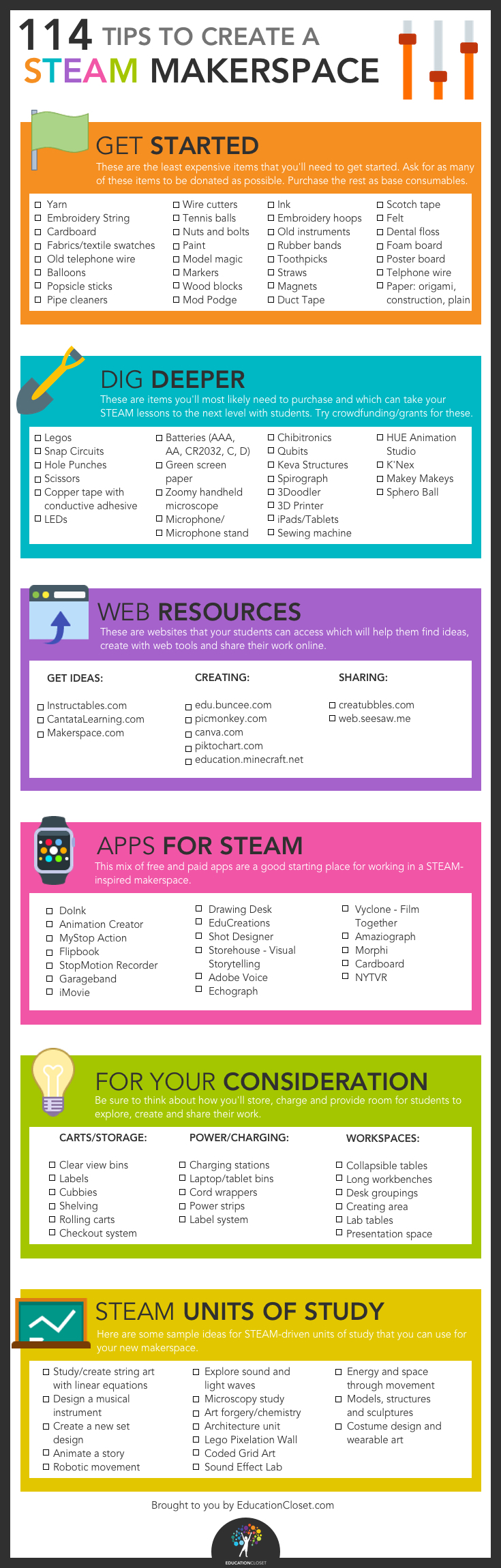
Deciding what to put in your makerspace or the right edtech to integrate into your classroom to transform learning can be overwhelming. Let me do the heavy lifting for you!
Friday, July 7, 2017
Monday, July 3, 2017


Thursday, June 15, 2017
Wednesday, June 7, 2017
Math Quote

“No matter how engaging the lecturer may be, sitting still, listening to someone talk, and attempting to transcribe what they have said into a notebook is a very poor substitute for actively engaging with the material at hand, for doing mathematics.”
The Shift from Engaging Students to Empowering Learners
Here's a video that highlights this shift from student engagement to student empowerment. If you connect at all with this video, please like it, comment on it, and share it out. Don't forget to subscribe to my channel as well.

Monday, May 15, 2017


Thursday, May 11, 2017

Wednesday, May 10, 2017


Monday, May 1, 2017
Tuesday, April 25, 2017
Teacher's Guide to Computational Thinking

Computational thinking is a cognitive or thought process involving logical reasoning by which problems are solved and by which artifacts, procedures and systems are better understood. It embraces:
The ability to think algorithmically
The ability to think in terms of decomposition
The ability to think in generalizations, identifying and making use of patterns
The ability to think in abstractions, choosing good representations, and
The ability to think in terms of evaluation.
Computational thinking can be applied to a wide range of entities including: human created objects, systems, processes, objects, algorithms, problems, solutions, abstractions, and collections of data or information.

Subscribe to:
Posts (Atom)