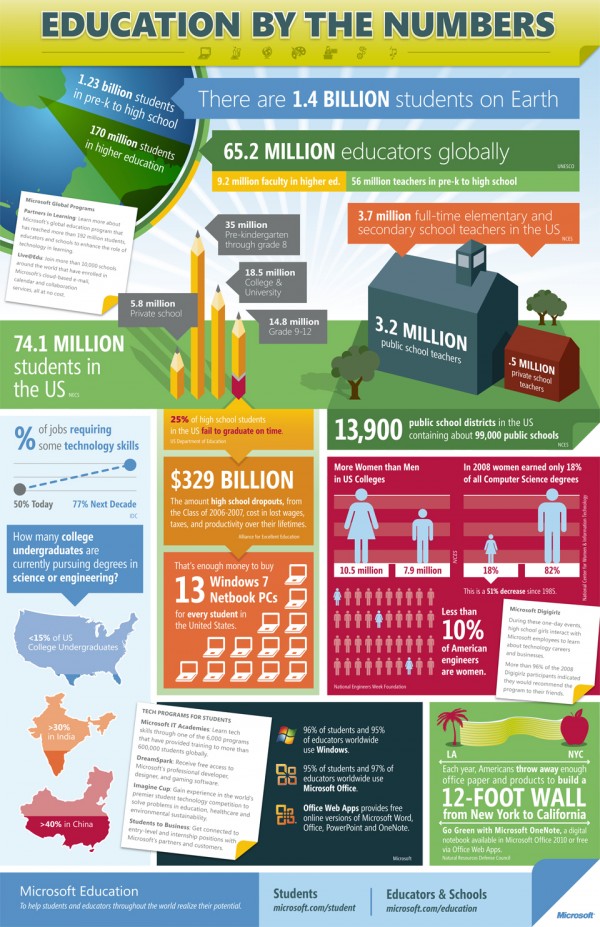
See larger and download version HERE
Showing posts with label trends in education. Show all posts
Thursday, June 23, 2016
Monday, May 9, 2016
Teacher Driven Change
Most elected leaders and educational bureaucrats tend to view the public schools in deficit terms and seldom focus on individual and school-wide strengths.
Tuesday, February 23, 2016
Innovating Pedagogy Report - Infographic
Image credit: Stephen Valdivia
- Crossover Learning: Learning in informal settings, such as museums or meetups. Such settings can spark further interest and motivation to learn.
- Learning Through Argumentation: Learning by establishing and refuting claims, in ways similar to professional scientists and mathematicians.
- Incidental Learning: Unplanned or unintentional learning that contributes to longer term learning paths, often via technology, especially mobile.
- Context-based Learning: Learning from experience by interpreting new information and relating it to what we already know. For example, students interacting with surroundings other than a lecture hall, that relate to the given topic.
- Computational Thinking: Learning that breaks large problems down into smaller ones, uses pattern recognition, algorithms, abstraction, and debugging for problems that aren’t even related to math or science necessarily.
- Learning by Doing: Learning with authentic tools and practices. The traditional example is the science labratory. New, technology-enabled examples have emerged involving remote labs, and adaptive simulations.
- Embodied Learning: Learning that involves self-awareness of the body interacting with the real or simulated world, in a way that the mind and body work together so that physical feedback and actions reinforce the learning process. Think interactive surfaces with multi-touch screens or wearable devices like Google Glass.
- Adaptive Teaching: Uses data about a specific learner’s previous learning to create personalized paths.
- Analytics of Emotions: Understanding student mindsets in cognitive and non-cognitive aspects, including frustrations, distractions, even eye tracking.
- Stealth Assessment: Automatic data collection techniques (such as in games like World of Warcraft) in which actions are continually collected to make inferences about the particular student’s goals and strategies, to then present new, appropriate challenges.
Wednesday, January 6, 2016
Whitepaper: Preparing Students for a new world of work in the 21st Century
“The spread of computers and the Internet will put jobs in two categories: People who tell computers what to do and people who are told by computers what to do.”
Marc andreessen inventor of Netscape
“If you think you’re finished, you’re finished.
In today’s job market, everyone needs
to be a work in progress.”
Reid ho man, Co-founder of LinkedIn
Read the full whitepaper (PDF)
Labels:
future of education,
trends in education,
whitepaper
Wednesday, December 16, 2015
Education 3.0
Tuesday, September 8, 2015
Wednesday, July 22, 2015
Tuesday, June 16, 2015
Attention Grabbers
Wednesday, May 13, 2015
The Modern Day Classroom
Wednesday, April 22, 2015
Thursday, December 11, 2014
Monday, December 8, 2014
Allow pupils to use Google in exams
Allow pupils to use Google in GCSE exams, says academic
A Harvard physics professor says schoolchildren must be allowed to access the internet and talk to friends in the exams hall to reflect the conditions seen in the workplace
Thursday, November 13, 2014
RAT: The new SAMR model
R :: replacement | redundant | retrograde
A :: augmented | average | acceptable
T :: transformed | terrific | tremendous
SAMR is almost impossible to pronounce, in English anyway, and while it's simpler than most, it can be simpler, without, I believe, losing anything that is crucial. I don't need to wrestle with the distinction between Augmentation and Modification, seriously—is it that important? What I do see on a really bad day, is tech that is not just replacement, but worse; allow me to reiterate, people using computers in ways that are actually WORSE than not using tech at all—like the person who insists on printing out name labels for each kid, I mean, really? Just get a pen and a write the name on a sticker. I'll tell you what level of integration that is— Retrograde.
Technology as Transformation
The Technology as Transformation Category involves technology use that transforms the instructional method, the students' learning processes, and/or the actual subject matter.
- The actual mental work is changed or expanded
- The number of variables involved in the mental processes are expanded
- The tool changes the organisation in which it had been used
- New players become involved with the tool's use (or expanded use of the tool).
- New opportunities for different forms and types of learning through problem solving, unavailable in traditional approaches, are developed.
... it [transformative use of ICTs] improves the process of bringing thought into communicable expressions in such significant ways that, once the tool is understood and used regularly, the user feels wanting if it is not available because it has opened up new possibilities of thought and action without which one comes to feel at a disadvantage. It's become an indispensable instrument of mentality, and not merely a tool. (Pea, 1985, p 175)
Many of the innovations, particularly those that provide online content and learning materials, use basic pedagogy – most often in the form of introducing concepts by video instruction and following up with a series of progression exercises and tests. Other digital innovations are simply tools that allow teachers to do the same age-old practices but in a digital format. Examples include blog entries instead of written journals and worksheets in online form. While these innovations may be an incremental improvement such that there is less cost, minor classroom efficiency and general modernisation, they do not, by themselves, change the pedagogical practice of the teachers or the schools. (Fullan M & Donnelly K, 2013, p25)
From: Digital literacy blog
Thursday, September 4, 2014
The change all our schools need
This was taken from ditch that textbook... Excellent points, and seems common sense, yet teachers cling to an industrial model for education like it is the be all of humanity... Why?
1. “Why does school stink? Because most of what students do is based on compliance.”
For decades, schools have adopted and pushed a culture of “do exactly as the teacher says.” It was a very desirable trait in employees for many, many years. But the world has changed, and so have the needs for the workforce. Employers are looking for communicators, creative thinkers and problem solvers. A culture of compliance won’t produce those attributes.
2. “Schools should be democratic, messy, loud places where kids are everywhere.”
Lehmann speaks of his joy in walking around the Science Leadership Academy armed with his iPhone taking pictures. There’s a lot to photograph because students are everywhere — creating, testing, tinkering and trying. He’s right. Schools should be democratic: students should have a voice and input in what the school looks like, stands for and teaches them. They should be messy: taking risks and giving up control are messy but can be very fruitful. They should be loud: team work and collaboration doesn’t happen in silent rows.
3. “Classes should be bridges, not silos.”
Learning doesn’t have to happen inside the four walls of the classroom anymore. Collaborative tools let students share ideas in blogs, publish their work in websites, connect with other countries through video chats and work with others around the world in shared documents. We can break down the walls and broaden our students’ horizons, or we can keep the walls up and fence them in.
4. “Technology should be ubiquitous, necessary and invisible.”
Technology can’t be a class or a special day in class. If we use it that way, it becomes the focal point instead of a tool to help us achieve more. It should be ubiquitous — everywhere — especially where it can make what we do more efficient or empower us to do more. It should be necessary, because so many things we can do with technology can’t be done without it. It should also be invisible; when schools work with technology and don’t think about it anymore, it is truly integrated.
5. “Data-driven requires good data — and good data ain’t cheap.”
So many schools base so many decisions on results of standardized tests. They can provide some solid data, but it’s not always the best, and it’s not always what schools really need. Many of them don’t give any indication of how students will perform on those critical skills mentioned earlier: communication, problem solving and creative thinking. Schools should invest — and by invest, I mean time and effort as much as money — in good data.
6. “We’ve got to build caring institutions. We teach kids, not subjects.”
Lehmann suggests that math teachers quit saying they teach math, and that first grade teachers quit saying they teach first grade. Teachers teach kids. He contends that the relationship between student and teacher is more important than the relationship between teacher and subject.
Thursday, June 19, 2014
The New Bloom’s Taxonomy
1. What will the students (not the teacher) be doing in this lesson, recalling and showing understanding (lower) or analyzing and evaluating to create a product (higher)?
2. Will students be expected to respond with specific, known answers (lower) or will they be asked to generate original thought (higher)?
Wednesday, June 11, 2014
Subscribe to:
Posts (Atom)